When it comes to the elite world of professional audio engineering and production, Adrian Hall is a name that commands immediate respect. With a career spanning over two decades, Hall has established himself as a versatile powerhouse in the London music scene and beyond. His portfolio reads like a “who’s who” of modern music history, having collaborated with legendary artists such as The Black Eyed Peas, Alicia Keys, Robbie Williams, Goldfrapp, and Depeche Mode.
String Ensemble Recording with the OC818
In this session, Adrian Hall records a 10-piece string section under social distancing restrictions, which forced the players to be spaced further apart than usual. To counter the resulting “hollow” center in the stereo image, he employs a modified Decca Tree setup using a pair of OC18s for the wide image and an OC818 as a dedicated center microphone. By capturing both capsules of the OC818, Hall demonstrates how he uses the PolarDesigner plugin during the mix to switch the center mic to a Figure-of-Eight pattern. This specific move adds a significant “weight” and low-end richness to the ensemble, filling the middle of the sonic picture while maintaining a pocket of space for the lead vocal to sit perfectly in the center.
Drum Mixing: Rebalancing the Kit Post-Recording
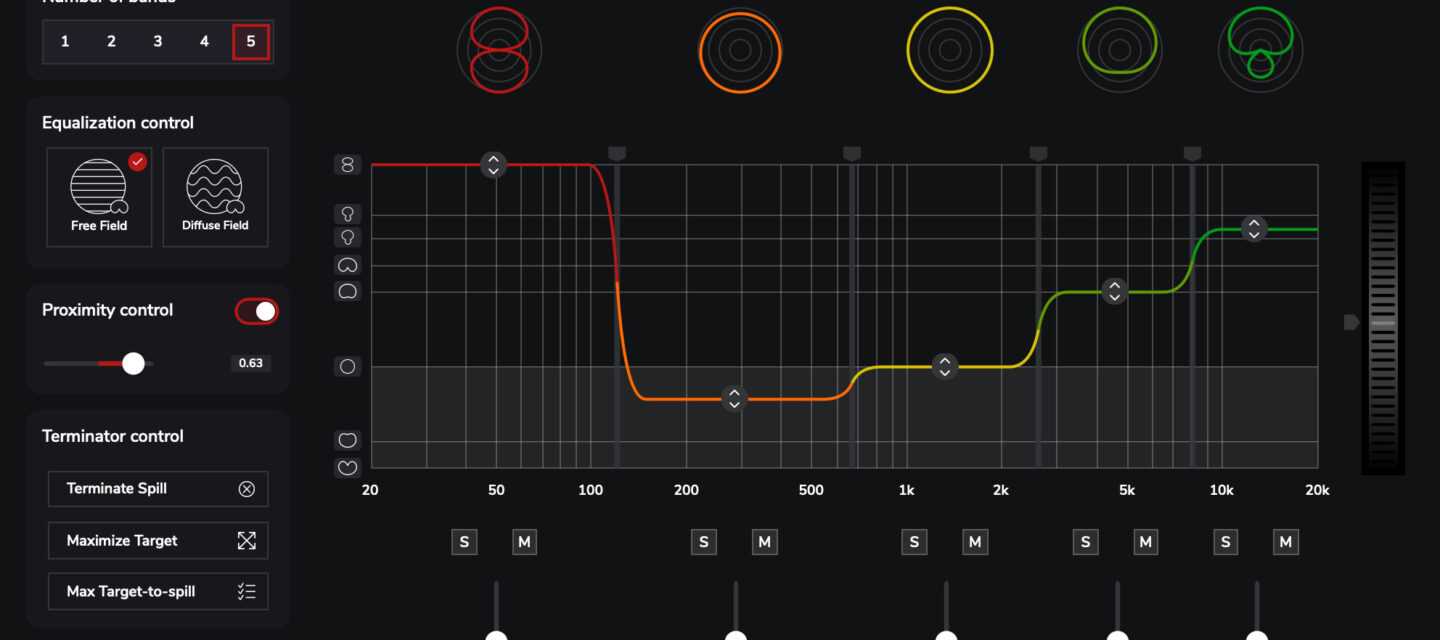
Focusing on the revolutionary capabilities of frequency-dependent polar patterns, Hall showcases how to treat a single microphone as a multi-track source. He places the OC818 in front of a drum kit and uses the PolarDesigner to split the signal into three distinct frequency bands. He assigns Omni to the low end (up to 400Hz) to capture a full, solid kick drum, Figure-of-Eight to the mid-range to tighten the snare focus and reduce “clutter,” and a Reverse Cardioid for the high frequencies to attenuate harsh hi-hat splash. This approach effectively allows him to rebalance the fundamental elements of the drum kit—kick, snare, and hats—long after the drummer has left the studio.
Drum Character and Processing
In this video, Hall explores the OC818’s role as a “character” microphone for drums. He highlights the stark difference in kit tonality when toggling between global polar patterns in a real-world mix context. By combining the natural transparency of the CKR12 ceramic capsule with post-processing tools like distortion, phase trim, and EQ, he illustrates how the microphone provides a highly malleable foundation. The focus here is on achieving a “punchy” and “solid” sound, demonstrating that even when used as a single kit mic, the ability to fine-tune the pickup pattern via software allows for a level of punch and focus that traditional fixed-pattern microphones cannot match.