


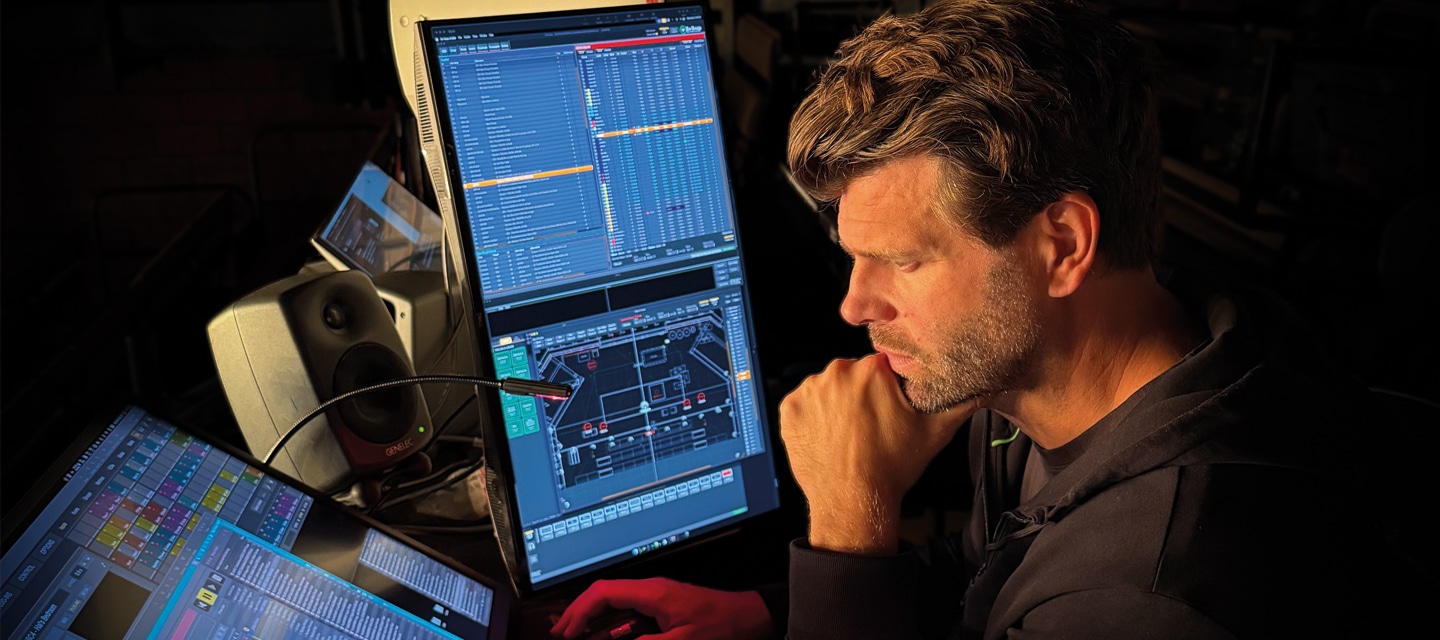
Gareth Owen is an acclaimed, multi-award-winning West End and Broadway sound designer with numerous Tony and Olivier awards and nominations to his name. Renowned for his work on massive theatrical productions across the globe, Owen has built a reputation for pushing the boundaries of live sound design and demanding the absolute highest standard of acoustic fidelity for modern musicals.
Austrian Audio: How did you first come across Austrian Audio?
Gareth Owen: Matt Wandless at DPA suggested I give them a try. I’ve always been guided well by him so I took a punt and I haven’t looked back.
Austrian Audio: Since your introduction happened through a demo organized by the DPA Microphones UK partnership on & Juliet in Toronto, how do you feel about having access to Austrian Audio’s lineup through this collaborative network?
Gareth Owen: Well, I wouldn’t have discovered this great new mic without it.
Austrian Audio: You mentioned that for your entire career you relied on one specific pair of overhead mics, but that changed during the demo in Toronto. What was the exact moment or sonic discovery that convinced you to make the switch?
Gareth Owen: The exact moment I realised I was never going back was roughly fifteen seconds after I shoved the faders up on the overheads. I was literally like “oh, that’s what the overheads are supposed to sound like…”
Austrian Audio: You called the OC818 “hands down the best drum overhead I’ve ever used.” What specific features or sound characteristics stand out most to you?
Gareth Owen: Clarity without distortion, and transient response are standout. Transient response specifically is something I’ve always struggled to quantify on paper – no spec sheet accurately represents it.
Austrian Audio: When mixing drums for complex musical theatre productions, what are the biggest acoustic challenges you face with overhead microphones?
Gareth Owen: There is rarely room to let the drums breath. If we were in a studio we’d put the drums in a huge wooden room. In a theatre we regularly cram them in to a broom closet. This makes the techniques for getting a good drum sound somewhat different and considerably more challenging.
Austrian Audio: The OC818 offers multiple polar patterns and dual-output capabilities. Do you take advantage of these advanced features in a live stage environment, or do you stick to a specific setup?
Gareth Owen: So far we have stuck to a cardoid pickup pattern with a single output, but I’ll continue to explore the possibilities.
Austrian Audio: How seamlessly does the microphone integrate into your existing signal chains and console workflows?
Gareth Owen: Like it’s always been there.
Austrian Audio: With Thelma & Louise opening at London’s Young Vic this September, how are you utilizing the OC818 for this specific production?
Gareth Owen: Indeed. And also for Purple Rain and Paddington on Broadway and the MJ Asian Tour around the world.
Austrian Audio: Does the intimate or specific stylistic vibe of a venue like the Young Vic change how you approach miking the drums compared to a massive West End stage?
Gareth Owen: Theatre sound is theatre sound regardless of the venue. Everything is way more tricky than it feels like it ought to be – I honestly can’t remember the last time a show was easy!
Austrian Audio: What is your core philosophy when it comes to delivering sound for the stage?
Gareth Owen: My job is to reproduce the performance as accurately as possible across the entire audience. I cannot imagine anything more frustrating as a musician (or singer, composer, lyricist or orchestrator) than to not feel like your work is being delivered to its maximum potential.
Austrian Audio: Studio-grade microphones are increasingly finding their way onto demanding live stages. Why do you think studio-quality gear is becoming more essential for modern live sound design?
Gareth Owen: Yes. As live sound equipment improves in quality the idosyncratic behaviour of live systems becomes less and less of a hindrance. Pattern control on speakers keeps sound away from microphones, cleaner signal paths in mixing consoles reduces distortion, and better stage foldback reduces bleed and crosstalk between sound sources. While there is still a place for live microphones, the strict need for them is becoming less and less. At this point, most of the mics we use are not specific live models. We ever use large diaphragm studio mics onstage for one show and they sound glorious.
Austrian Audio: What advice would you give to up-and-coming sound engineers who are trying to achieve that pristine, studio-level drum sound in a live theatrical mix?
Gareth Owen: Isolation. It’s all about isolation. Try to isolate the drums as much as possible from the PA system. And make sure the drums sound good in the first place – you can’t make a bad sound source sound good no matter what mics you have.